STUDY IN
USA
September 2026 Intake Now Open. Transform your career with world-class education.
Your USA Roadmap
Get a step-by-step guide to top universities and visa success.
- University Selection
- Scholarship Check
- Visa Timeline
Visa Roadmap
Leading Universities
Why study in USA
Experience an immersive and collaborative education by choosing to Study in USA, where you can access some of the most prestigious higher education systems, high-end technology, and cutting-edge research in the world. When you Study in USA, you gain access to an extensive range of schools and niche qualifications within a uniquely flexible system that allows you to tailor your programs to suit your specific academic and career goals. Graduate with a truly global outlook and the real-world skills necessary to lead in the future
Estimated Living Expenses
| Category | Cost (USD ($)) | Frequency | Trend |
|---|---|---|---|
| Accommodation | $800 - $1,500 | Monthly | 2026 Est. |
| Food & Groceries | $300 - $500 | Monthly | 2026 Est. |
| Utilities | $150 - $250 | Monthly | 2026 Est. |
| F1 Student Visa | $185 | One-Time | 2026 Est. |
| SEVIS Fee | $350 | One-Time | 2026 Est. |

Application Documents
Documents required to study in the USA
When applying for a course in the USA as an international student, you typically need several documents to complete the application process. These documents may vary depending on the institution and the specific program, but some common ones include:
- Application Form
- Application Fees
- Statement of Purpose / Essays
- Resume
- Recommendation Letters
- Academic Transcripts
- Marksheets & Certificates
- Bank Certificate
- Declaration Certificate of Finance.
- Test Score Report.
Visa Documents
USA Study Visa Documentation
All the efforts to study abroad become futile if you do not present your case effectively and assertively during visa interviews. We provide comprehensive VISA guidance, which includes verifying the bank financial statement, latest update on VISA TECHNOLOGY & RESEARCH, mock interviews, etc. Mentioned below are the general steps for the procurement of a study visa in the USA
- Obtain I-20 from University / College
- Pay the SEVIS fee & Complete DS-160 form
- Pay Visa Application Fees
- Schedule interview date
- Attend scheduled appointment with all the necessary documents
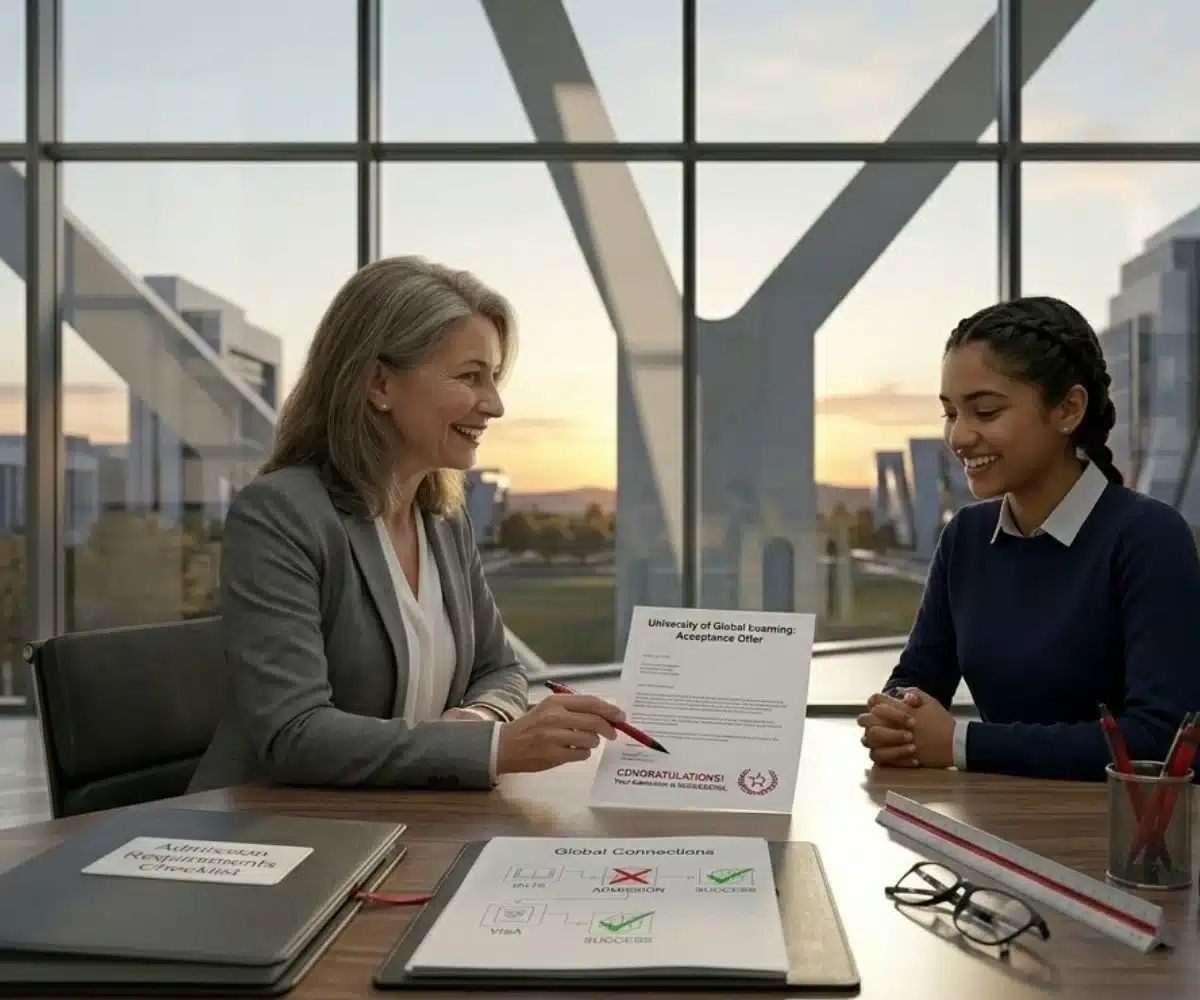
Admission Requirements
Admission requirements for UG and PG programs differ across US universities. Below are the general requirements typically needed to secure your spot at a USA institution:
- Academic Records: Official transcripts from previous institutions.
- Standardized Tests (UG): SAT or ACT results for undergraduate admissions.
- Standardized Tests (PG): GMAT or GRE results for graduate admissions.
- English Proficiency: TOEFL, IELTS, PTE, or Duolingo scores.
- Personal Assets: Personal essay and Statement of Purpose (SOP).
- Professional Proof: Letters of recommendation and an updated Resume/CV.
- Legal & Financial: A copy of your valid passport and financial documentation.
Student Visa in USA
There are three types of student visas in USA and each of them solves a different purpose. Check out the table below to understand the different types of student visas in USA and how they differ from one another:
| Factors | F1 Visa USA | J1 Visa USA | M1 Visa USA |
|---|---|---|---|
| Meaning | The F1 visa in USA is for those whose courses are 18 months and longer. | J1 visa in USA is for exchange program students. | M1 visa in USA is for applicants coming to study vocational courses. |
| Eligibility | Applicants who qualify for US university admissions offered full-time. | This visa is applicable for international students coming for exchange programs to USA. | This visa is applicable for those coming to study vocational education courses. |
| Application or MRV Fee | USD 185 | USD 185 | USD 185 |
| SEVIS Fee | USD 350 | USD 220 | USD 350 |
| Interview | F1 visa interviews are required unless you meet the criteria for the Dropbox option in the USA. | J1 visa interviews are also mandatory. | M1 visa interviews are also mandatory to get student visa. |
Important Note for Applicants:
International students seeking admission to the USA should be aware that the processing times for student visas can differ significantly. To ensure a smooth application process, it is crucial for applicants to avoid scheduling their interviews at the last minute. They should obtain their I-20 in a timely manner and complete the DS-160 visa application form, pay the SEVIS fee, and gather all necessary documents, including biometric information for the OFC appointment. Securing a student visa is essential for anyone wishing to study in America.
Post-Study Work Permit in USA
International students need an F1 visa to pursue their studies in the United States. This visa grants them a 60-day grace period to remain in the country following their graduation. After finishing their degree, F1 visa holders have the opportunity to apply for Optional Practical Training (OPT), which is a one-year work authorization that allows them to gain practical experience in their field. The chance to work in the U.S. after completing their studies is a significant reason many students opt for higher education in the country. It’s essential for students to be well-informed about the post-study work options available in the U.S. before they apply for their programs.
What does OPT mean?
Optional Practical Training (OPT) refers to a temporary employment opportunity specifically designed for F-1 students, allowing them to work in positions directly related to their field of study. This program enables international students holding an F-1 Visa to engage in work for up to 12 months in their area of expertise. Students can apply for OPT employment authorization either before they finish their studies (pre-completion) or after graduation (post-completion). While the standard duration is 12 months, those with a STEM degree may qualify for an extension of an additional 17 months. It’s important to note that any time spent in pre-completion OPT will reduce the available time for post-completion OPT. Generally, working in a country without the appropriate documentation is not permitted for non-citizens. Therefore, for international students in the U.S., obtaining the necessary authorization through OPT is essential.
Documents Required for OPT Visa:
Applicants are recommended to approach the international office at their respective institutions directly to get details regarding the documents required. But generally, the below-mentioned documents may be relevant:
- 2 passport-size photographs
- I-765 (original)
- Present passport copy
- A printout of I-94
- US$380 (subject to change) personal check which should be addressed to the Department of Homeland Security
- Copy of OPT recommendation and I-20
- Copy of all the earlier issued I-20s
- Any earlier issued EAD card copies
- F-1 visa stamp’s copy on passport
Eligibility for OPT Visa:
A student should:
- Possess an F1 status
- Be enrolled full-time for one academic year before the employment begins
- Not have used 12 months or more of full-time CPT
Student Success Stories


Harshit Ranjan
"Sanjana Mam and Rahul Sir helped me secure a Fully Funded Master’s in Italy. Their expertise made my dream a reality."


Ekene Elo Atueyi
"Moving to the UK with my family was seamless thanks to Sanjana and Bhawana Mam. They handled my spouse visa flawlessly."

Fayeza Bhatt
"Priya Mam’s CAS preparation was excellent. The team helped with finances, course selection and documentation."

Priyanka Jaiswal
"The Martiza team provided a seamless application process and arrival guidance. Highly recommend their services!"


Ratish Ranjan
"Pranay Sir and the team handled my journey from selection to departure with great care and professionalism."

Saurav
"Sheli Mam and Pranay Sir helped with university selection and funding. Visa approval was very smooth."
Study In USA FAQs
Why do most international students prefer coming to the USA for study?
How much do tuition fees in the USA cost?
Is it possible to study in the USA without taking an English proficiency test?
Most US universities expect international students to prove their English proficiency. This is typically done through tests like TOEFL or IELTS. However, some universities may waive this requirement if you have previously studied in English or if you come from a country where English is the primary language.
Cost of living while studying in the USA:
Living expenses in the United States can vary widely depending on the location. On average, students can expect to spend about $10,000 to $20,000 annually on housing, food, transportation, and personal expenses. Generally, rural areas tend to be more affordable compared to cities like New York, Boston, or San Francisco.
Do international students have the right to work in America while studying?
What are the choices after graduation in the US?
F-1 visa holders can apply for OPT after graduating from college. OPT allows international students to work in the United States for 12 months. For STEM graduates, this period can be extended by an additional 24 months, covering fields like Science, Technology, Engineering, and Math. After completing OPT, students can apply for work visas such as the H-1B.
Is it a good location for research and innovation in the USA?
The United States is a global leader in research and innovation, with top universities engaged in cutting-edge research across various fields. There are numerous research opportunities for students, and many institutions collaborate with industries and government entities.